
Arctic sea ice minimum remains low, with the past 20 years at the bottom of the record
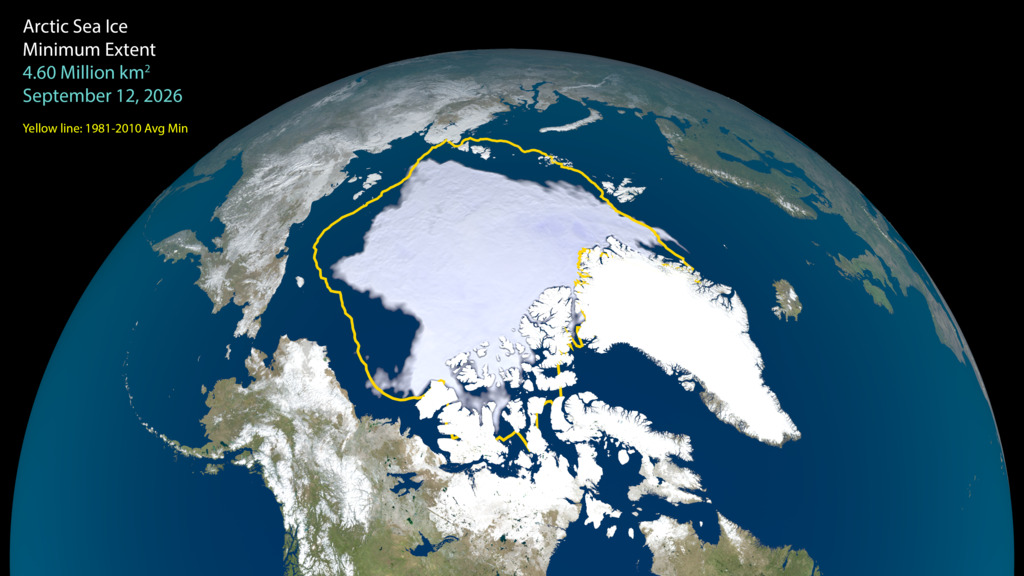
Arctic sea ice reached a preliminary annual minimum of about 4.6 million square kilometres on 12 September. NASA and the National Snow and Ice Data Center reported the finding on 23 September, ranking it tied tenth lowest in the satellite record.
The longer sequence matters more than a single ranking. The 20 years from 2007 to 2026 account for the 20 lowest annual minima in the continuous satellite record. Failure to set a fresh record does not represent a return to earlier conditions.
Sea ice expands in autumn and winter and retreats in spring and summer. Winds, clouds and seasonal weather affect both melting and the distribution of ice, producing differences between neighbouring years.
Extent describes the distribution of ice-covered ocean. It is not a measure of ice volume and cannot, on its own, establish thickness or the survival of older ice. Those questions require other observations.
NSIDC cautioned that the minimum was preliminary: wind-driven compaction could still alter the figure. This report concerns September observations and the assessment released on 23 September, rather than a new measurement taken on 3 October.
Sources: NASA / NSIDC · 2026-09-23 · NSIDC · 2026-09-23
NASA Scientific Visualization Studio / Trent L. Schindler. Visualization of 12 September 2026 sea ice, released 23 September; AMSR2 data courtesy of JAXA.
Source: NASA / NSIDC
This article is based on publicly available information or editorial materials and does not imply endorsement by any institution mentioned unless expressly stated.
Published by Euro International Press (France). Individual readers, schools, associations and non-commercial organisations may republish this article while retaining the title, text and source. Media organisations, commercial websites, news platforms, aggregators and commercial entities should contact info@gche.eu for authorisation, syndication or partnership.
© Euro International Press. All Rights Reserved.