 EUROPE IN FOCUS. THE WORLD IN PERSPECTIVE.Submit News
World Cup 2026 and Football Culture: How a Tournament Becomes a Global Urban Festival
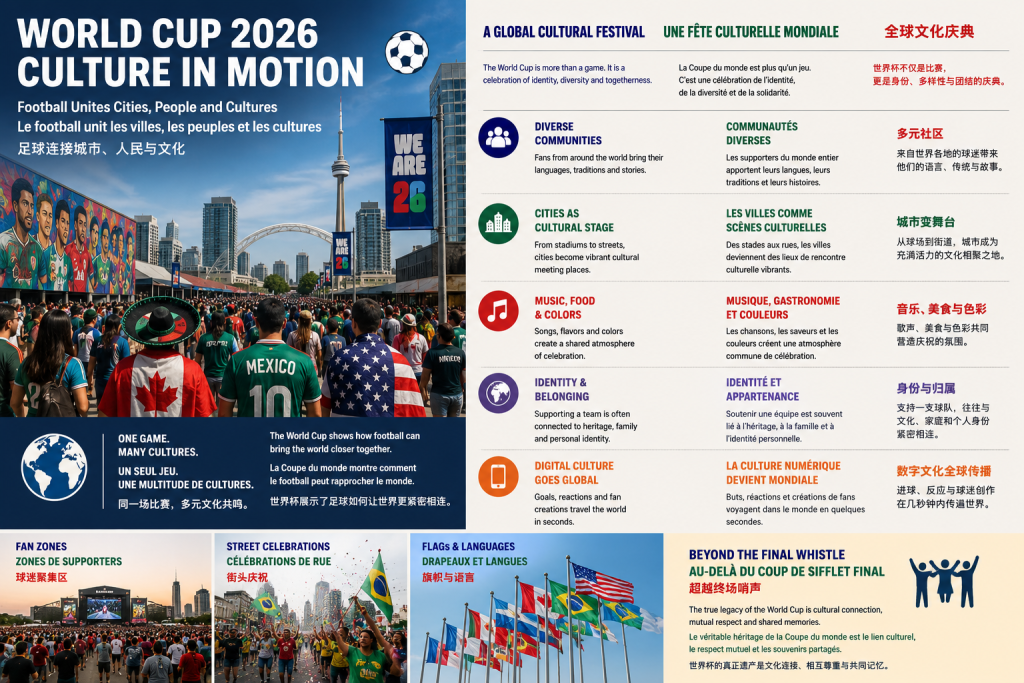
The 2026 FIFA World Cup is not only a competition between national teams. It is also a vast cultural event, bringing together languages, flags, songs, food, fashion, migration stories and public emotions across North American cities. For a few weeks, football turns streets, airports, cafés, stadiums and fan zones into a global stage.
The cultural power of the World Cup comes from the fact that football is both local and universal. A match may be played in one city, but the emotions belong to people from many countries. Supporters bring their own songs, colours, family memories and national symbols. In this sense, the World Cup is not just watched; it is performed by the fans.
The 2026 edition is especially significant because it is hosted across the United States, Canada and Mexico. These three countries are already shaped by migration, multilingual communities and cross-border cultural exchange. In cities with large diasporas, a match can become more than a sporting event. It can become a moment of recognition for communities that live between cultures.
Football culture is also visible in ordinary urban life. During the tournament, cafés become viewing rooms, neighbourhoods become gathering points, and public squares become places of collective emotion. People who may not follow club football every week still join the World Cup because it offers a shared language of celebration, tension and belonging.
For younger generations, the World Cup is also a digital cultural event. Reactions, memes, short videos, fan chants and street celebrations move rapidly across social media. A goal scored in one stadium can become a global visual moment within minutes. This digital layer changes the way football culture travels, making it faster, more emotional and more participatory.
The tournament also reveals how sport and identity are connected. National teams carry symbols of history, migration and memory. For many families, supporting a team is linked to parents, grandparents, language, hometowns or childhood memories. In multicultural societies, it is common for people to support more than one team, reflecting complex and layered identities.
At the same time, the World Cup can create tensions. National pride can become excessive, commercial branding can overwhelm local culture, and host cities must balance celebration with security, public order and respect for residents. A successful cultural World Cup is not only about full stadiums; it is also about how cities welcome visitors without losing their own rhythm.
The deeper meaning of the World Cup lies in its ability to make global culture visible. It shows how people use football to express joy, memory, identity, rivalry and hope. Beyond the scoreline, the tournament becomes a mirror of contemporary urban life.
In 2026, the most lasting images may not only be goals and trophies. They may also be streets filled with different languages, families wearing mixed colours, neighbours watching together, and cities discovering how football can briefly turn the world into one public square.
—
Copyright Notice
This article is published by Euro International Press.
Individuals, schools, associations and non-commercial organisations may republish the article provided the title, content and source information remain unchanged and the source is clearly credited as Euro International Press (eipress.eu).
Media organisations, commercial websites, news platforms, syndication services and other commercial entities wishing to reproduce, translate, adapt, republish or commercially distribute this content should obtain prior authorisation.
Licensing & Syndication:
info@gche.eu
© Euro International Press. All Rights Reserved.
Source: Euro International Press
Photo / Image: Image: EIPRESS editorial visual.
This article is based on publicly available information or editorial materials and does not imply endorsement by any institution mentioned unless expressly stated.
Published by Euro International Press (France). Individual readers, schools, associations and non-commercial organisations may republish this article while retaining the title, text and source. Media organisations, commercial websites, news platforms, aggregators and commercial entities should contact info@gche.eu for authorisation, syndication or partnership.
© Euro International Press. All Rights Reserved.