
Europe EV Momentum Rebounds
CarIndexes.com, the European automotive index and market observation platform under Euro International Press (EIPRESS.eu), has released this week’s Europe Auto Index Weekly report. The latest data shows that the Europea…
Euro International Press (EIPRESS.eu) | CarIndexes.com Weekly Automotive Market Review
CarIndexes.com, the European automotive index and market observation platform under Euro International Press (EIPRESS.eu), has released this week’s Europe Auto Index Weekly report. The latest data shows that the European automotive market continues to experience a rebound in electric-vehicle interest, growing brand differentiation, more rational consumer decision-making and intensified competition around localized services.
CarIndexes.com is an automotive data and media platform under Euro International Press (EIPRESS.eu), focusing on the European automotive market, model popularity, brand visibility, electric-vehicle trends and industry observation. The platform conducts periodic analysis of the European automotive market based on public market information, industry data, media visibility, editorial indexes and platform-based user-behaviour signals.
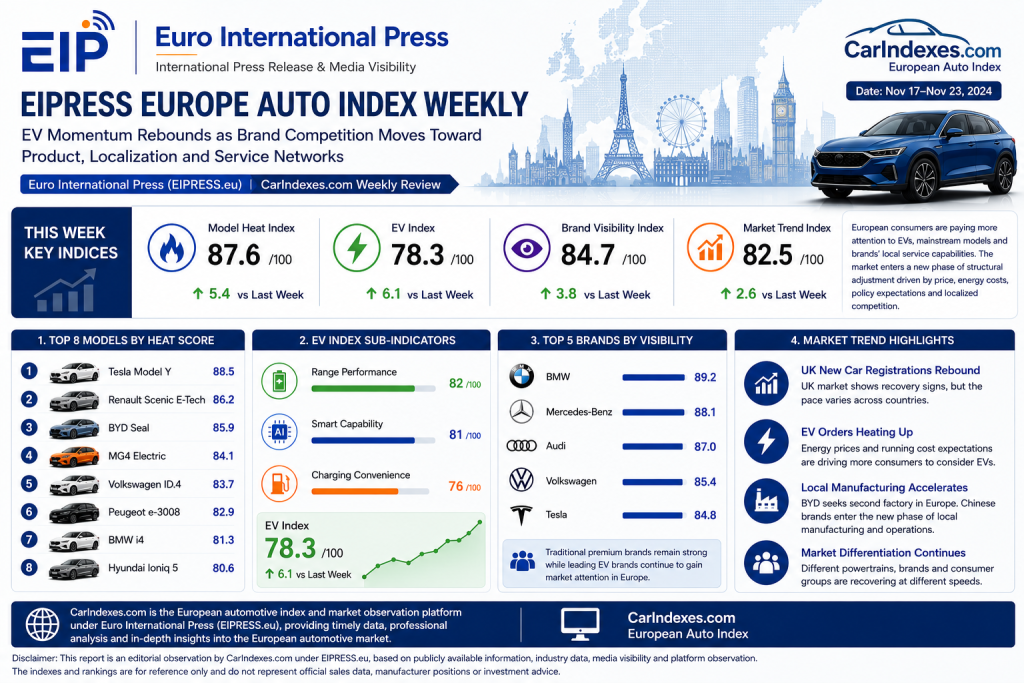
This week, the Model Heat Index reached 87.6/100, up 5.4 from the previous period. The EV Index reached 78.3/100, up 6.1. The Brand Visibility Index stood at 84.7/100, up 3.8, while the Market Trend Index reached 82.5/100, up 2.6. These movements suggest that the European automotive market is not simply entering a downturn, but rather moving into a new phase of structural adjustment shaped by pricing, energy costs, policy expectations and localized brand competition.
1. Model Heat Remains Concentrated Around Mainstream EVs and Family SUVs
This week’s model heat rankings continue to be led by mainstream electric vehicles and family-oriented new-energy models. The Tesla Model Y ranked first with 88.5/100, maintaining its strong recognition and consumer appeal in the European EV market. The Renault Scenic E-Tech ranked second with 86.2/100, followed by the BYD Seal in third place with 85.9/100. The MG4 Electric, Volkswagen ID.4, Peugeot e-3008, BMW i4 and Hyundai Ioniq 5 also entered this week’s key ranking.
This ranking indicates that European consumers are no longer focusing only on whether a vehicle is fully electric. Instead, they are making more comprehensive comparisons involving range, family space, fast-charging capability, price competitiveness, brand trust, after-sales service and residual value.
The Tesla Model Y remains strong, showing that leading models still enjoy significant advantages in consumer awareness and market communication. The performance of the Renault Scenic E-Tech and Peugeot e-3008 also demonstrates that European brands continue to have a solid user base in the family EV and compact SUV segments. The presence of the BYD Seal and MG4 Electric reflects the growing visibility and product competitiveness of Chinese brands in the European market.
2. The EV Index Rebounds as Energy Prices and Usage Costs Become Key Factors
This week’s EV Index reached 78.3/100, up 6.1 from the previous period. Among its sub-indicators, range performance scored 82, smart-vehicle capability scored 81, and charging convenience scored 76. These figures suggest that overall market attention toward EVs is recovering, although charging infrastructure and daily usability remain important factors in consumer decision-making.
Discussion around EV orders and ownership costs has increased noticeably in the European market. Changes in energy prices, expectations around fuel costs, urban commuting needs and home-charging conditions are jointly shaping consumer attitudes toward electric vehicles. For users with stable home-charging access, the long-term cost advantage of EVs becomes easier to recognize. For those relying on public charging, however, charging convenience, price transparency and network reliability remain major concerns before purchase.
CarIndexes.com therefore believes that this week’s increase in the EV Index does not mean the market has fully shifted into a single growth pattern. Rather, it shows that consumers are recalculating the overall value of electric vehicles. In the future, the key variables affecting the EV Index will not only be driving range and purchase price, but also charging experience, insurance cost, leasing prices, used-car residual values and after-sales service networks.
3. Brand Visibility Rises as Traditional Premium Brands Compete Alongside Leading EV Brands
The Brand Visibility Index reached 84.7/100 this week, up 3.8 from the previous period. Homepage brand-visibility data shows BMW, Mercedes-Benz, Audi, Volkswagen and Tesla among the leading names. This suggests that the European market still places great importance on the stability, service networks and product systems of traditional brands, while continuing to pay close attention to the technology and price competitiveness of leading EV brands.
The strong visibility of BMW, Mercedes-Benz and Audi shows that European consumers have not abandoned traditional premium brands during the EV transition. On the contrary, they expect these brands to provide more mature and comprehensive solutions in electrification, intelligent vehicle systems and after-sales service. Volkswagen’s position also confirms that the Volkswagen Group continues to hold a strong base in the European market.
At the same time, the continuing presence of Tesla, BYD, MG, Hyundai and Kia indicates that the boundaries of competition in the European automotive market are expanding. In the past, the European market was mainly shaped by European brands, Japanese brands and a small number of American brands. Today, Chinese new-energy vehicle brands are gaining much stronger visibility, and the market structure is shifting from traditional brand competition toward multi-region, multi-technology and multi-price-segment competition.
4. Market Trend: Europe’s Car Market Shows Signs of Recovery, but the Pace Remains Uneven
The Market Trend Index reached 82.5/100 this week, up 2.6. This change indicates that there are signs of recovery in the European automotive market, but the recovery remains uneven. The rebound in UK new-car registrations, warmer EV order sentiment, energy-price changes and localized manufacturing plans all form important market signals this week.
The recent recovery in UK registration data suggests that consumer demand is returning in some European markets. However, the UK has its own policy rhythm and a relatively mature financing and leasing system, so a single-month improvement in the UK should not be interpreted as a broad recovery across the entire European market. A more reasonable assessment is that the European automotive market is becoming increasingly differentiated, with recovery speeds varying across countries, consumer groups and powertrain types.
The rise in EV orders should also be understood with caution. Energy prices and fuel-cost expectations may encourage consumers to consider EVs earlier, but short-term order growth does not necessarily mean stable long-term demand. The true determinants of sustained EV market growth remain pricing, subsidies, model availability, charging networks, residual values and consumer trust.
5. Chinese Brands Enter a New Phase of Local Manufacturing in Europe
This week, BYD’s search for a second European factory became an important market signal. The competition of Chinese new-energy vehicle brands in Europe is moving from “entering the European market” toward “local manufacturing and local operations.”
The significance of local manufacturing is not limited to reducing logistics costs or responding to tariff pressure. It is also closely related to delivery cycles, supply-chain stability, job creation, policy acceptance and consumer trust. For automotive brands seeking a long-term presence in Europe, factories, component supply, after-sales systems and local service networks will all become important parts of brand competitiveness.
This also means that the next stage of competition for Chinese automakers in Europe will not be limited to price and equipment. It will become a competition of system capability. Brands that can build stable European supply chains, after-sales services, financing and leasing tools, residual-value management and brand trust are more likely to establish a lasting position in the European market.
6. Weekly Conclusion: Europe’s Automotive Market Is Entering a Phase of Comprehensive Value Competition
Overall, this week’s CarIndexes.com data shows that the European automotive market is entering a new phase of competition. Electric vehicles remain at the center of market attention, but consumers are no longer looking only at range and price. They are paying more attention to real usage costs, charging convenience, service networks, brand stability and long-term residual value.
The simultaneous rise of the Model Heat Index and EV Index shows that interest in new-energy vehicles remains present. The increase in brand visibility suggests that consumers are comparing mainstream and emerging brands more actively. The rise in the Market Trend Index indicates that the European car market is showing signs of recovery, while still undergoing differentiation and adjustment.
CarIndexes.com, the European automotive index and market observation platform under Euro International Press (EIPRESS.eu), believes that future competition in Europe’s automotive market will develop in three directions:
First, EV competition will move from single product parameters toward overall usage value.
Second, brand competition will move from communication visibility toward localized service capability.
Third, Chinese automakers in Europe will move from “market entry” toward “long-term localization.”
Therefore, this week’s keyword for the European automotive market is not simply “growth,” but “revaluation.” Consumers are reassessing the value of EVs, automakers are reassessing their European strategies, and the market is reassessing which brands truly have long-term competitiveness.
Disclaimer: This article is a weekly editorial market review by CarIndexes.com, the European automotive index and market observation platform under Euro International Press (EIPRESS.eu). It is based on public market information, industry data, media visibility, editorial indexes and platform observation. The indexes, rankings and market assessments mentioned in this article are CarIndexes editorial indicators and market observations. They do not represent official sales rankings, the position of any automotive manufacturer, ratings from third-party data providers, or investment advice.
—
Copyright Notice
This article is published by Euro International Press.
Individuals, schools, associations and non-commercial organisations may republish the article provided the title, content and source information remain unchanged and the source is clearly credited as Euro International Press (eipress.eu).
Media organisations, commercial websites, news platforms, syndication services and other commercial entities wishing to reproduce, translate, adapt, republish or commercially distribute this content should obtain prior authorisation.
Licensing & Syndication:
info@gche.eu
© Euro International Press. All Rights Reserved.