World Cup 2026 Economic Impact: Tourism, Jobs and the Real Value for Host Cities
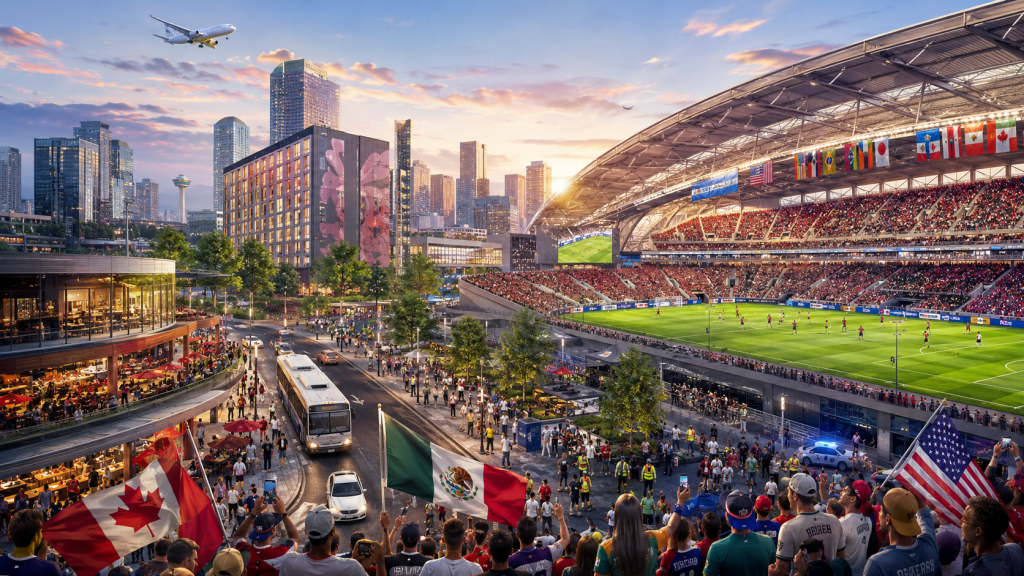
The 2026 FIFA World Cup is more than a football tournament. For the United States, Canada and Mexico, it is also a large-scale economic event that will test how host cities convert global attention into tourism revenue, hospitality demand, business visibility and long-term urban value.
As the first World Cup hosted across three countries, the 2026 edition has an unprecedented scale. With 48 teams, 104 matches and 16 host cities, the tournament creates a wider economic map than previous editions. Hotels, restaurants, transport operators, security services, event suppliers, local tourism agencies, retailers and media companies are all expected to benefit from the arrival of international fans and corporate visitors.
The most direct economic effect will come from tourism and local consumption. Visitors attending matches usually spend on accommodation, food, transport, entertainment, shopping and local experiences. For host cities, the most visible gains are likely to appear in hotel occupancy, restaurant traffic, airport activity, ride-hailing demand and fan-zone spending. Cities with strong tourism infrastructure may benefit more quickly because they already have hotels, airports, public transport and entertainment districts capable of absorbing large crowds.
The employment effect is also important, although much of it may be temporary. Major sporting events create demand for hospitality workers, drivers, security staff, event technicians, translators, media teams, volunteers, cleaners and logistics personnel. These jobs can support local income during the tournament period, but the long-term benefit depends on whether host cities can turn temporary activity into lasting business relationships and repeat tourism.
For businesses, the World Cup is also a visibility platform. Local brands, restaurants, hotels, cultural institutions and service companies can use the tournament to reach international visitors. For cities, the event acts as a global advertising campaign. A successful host city can strengthen its image as a destination for tourism, conferences, investment and future sports events.
However, the economic impact of the World Cup should not be exaggerated. Large countries such as the United States have enormous national economies, so even billions of dollars in additional activity may represent only a small macroeconomic effect. The real gains are likely to be local and sector-specific, concentrated in tourism, hospitality, transportation, media, retail and event services.
There are also costs and risks. Host cities may need to spend heavily on security, transport operations, public services, traffic management, temporary infrastructure and crowd control. If hotel prices rise too sharply, if transport becomes difficult, or if ticket prices discourage fans, the local economic effect may be smaller than early projections. Small businesses can also be excluded if sponsorship restrictions or official commercial zones limit their access to World Cup visitors.
The most realistic view is that the 2026 World Cup will be a powerful short-term economic accelerator for selected host cities, rather than a guaranteed national economic boom. Cities that prepare well can use the tournament to generate tourism income, showcase local culture, attract global media attention and build business links. Cities that rely only on matchday spending may see a short spike but limited lasting value.
In the end, the economic success of the World Cup will not be measured only by ticket sales or hotel bookings. It will depend on whether host cities can turn a month of global football attention into longer-term tourism, investment, cultural influence and business confidence.
—
Copyright Notice
This article is published by Euro International Press.
Individuals, schools, associations and non-commercial organisations may republish the article provided the title, content and source information remain unchanged and the source is clearly credited as Euro International Press (eipress.eu).
Media organisations, commercial websites, news platforms, syndication services and other commercial entities wishing to reproduce, translate, adapt, republish or commercially distribute this content should obtain prior authorisation.
Licensing & Syndication:
info@gche.eu
© Euro International Press. All Rights Reserved.
Source: Euro International Press
Photo / Image: Image: EIPRESS editorial visual.
This article is based on publicly available information or editorial materials and does not imply endorsement by any institution mentioned unless expressly stated.
Published by Euro International Press (France). Individual readers, schools, associations and non-commercial organisations may republish this article while retaining the title, text and source. Media organisations, commercial websites, news platforms, aggregators and commercial entities should contact info@gche.eu for authorisation, syndication or partnership.
© Euro International Press. All Rights Reserved.