
The Westward Migration of the Xibe People: A Living Memory of Eurasian Civilizations
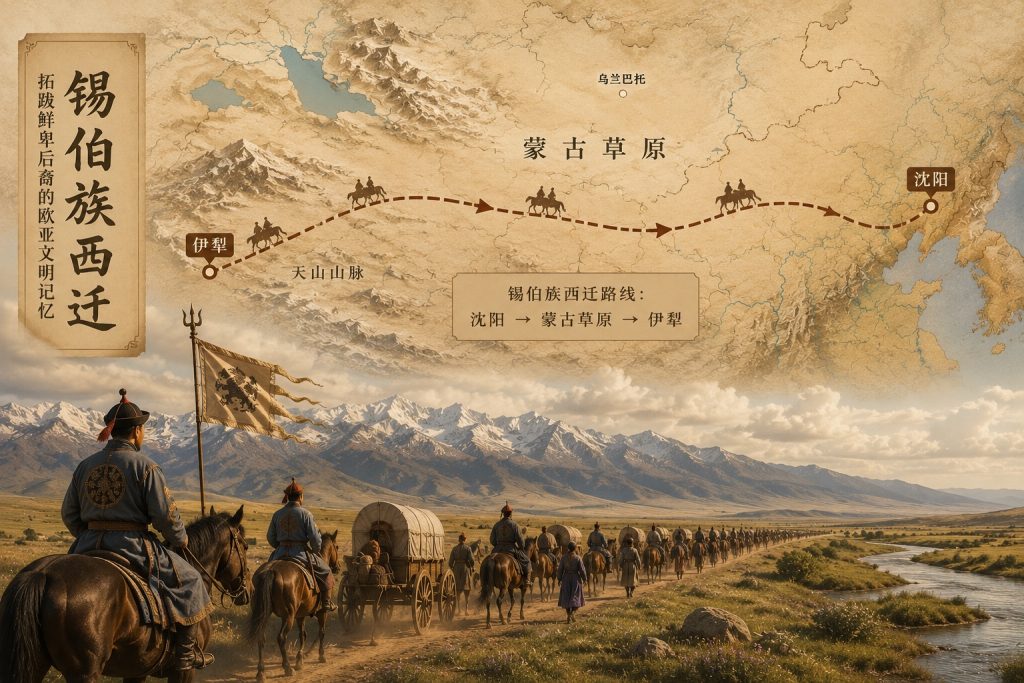
The Xibe people represent one of the most distinctive cultural communities in Chinese history. Descended from the Tuoba Xianbei, they preserve a remarkable historical legacy linking northern China, frontier development, linguistic heritage, and the broader story of Eurasian civilization. In the eighteenth century, the Qing Dynasty organized the westward migration of Xibe communities from the Shenyang region, across the Mongolian steppe, toward the Ili Valley in present-day Xinjiang. This journey of thousands of kilometers became a major chapter in the history of frontier governance and cultural preservation.
What makes the Xibe experience particularly valuable is the continuity of cultural memory. The Xibe people preserved their language, customs, oral traditions, festivals, and collective identity across generations. Their language and historical documents offer valuable material for research on the Manchu-Tungusic linguistic family, Qing institutions, frontier society, and Eurasian mobility. The story of the Xibe people is therefore more than a regional historical narrative. It is a reminder that migration can carry not only populations, but also language, memory, knowledge, and identity across time and space.
Huan Guan
Contributing Commentator, Europa Post
Editor: Alexander
Source: Euro International Press
Photo / Image: Image: EIPRESS editorial visual.
This article is based on publicly available information or editorial materials and does not imply endorsement by any institution mentioned unless expressly stated.
Published by Euro International Press (France). Individual readers, schools, associations and non-commercial organisations may republish this article while retaining the title, text and source. Media organisations, commercial websites, news platforms, aggregators and commercial entities should contact info@gche.eu for authorisation, syndication or partnership.
© Euro International Press. All Rights Reserved.