
From Box Office Growth to Global Storytelling: The Development of China’s Film Industry and Its Expanding International Influence
Europa Post | Cultural Perspective
Over the past two decades, China’s film industry has experienced remarkable growth. From the expansion of its domestic market to advances in film industrialization, and from international cooperation to the development of global distribution channels, Chinese cinema is gradually evolving from a major film market into a significant force in the global film industry.
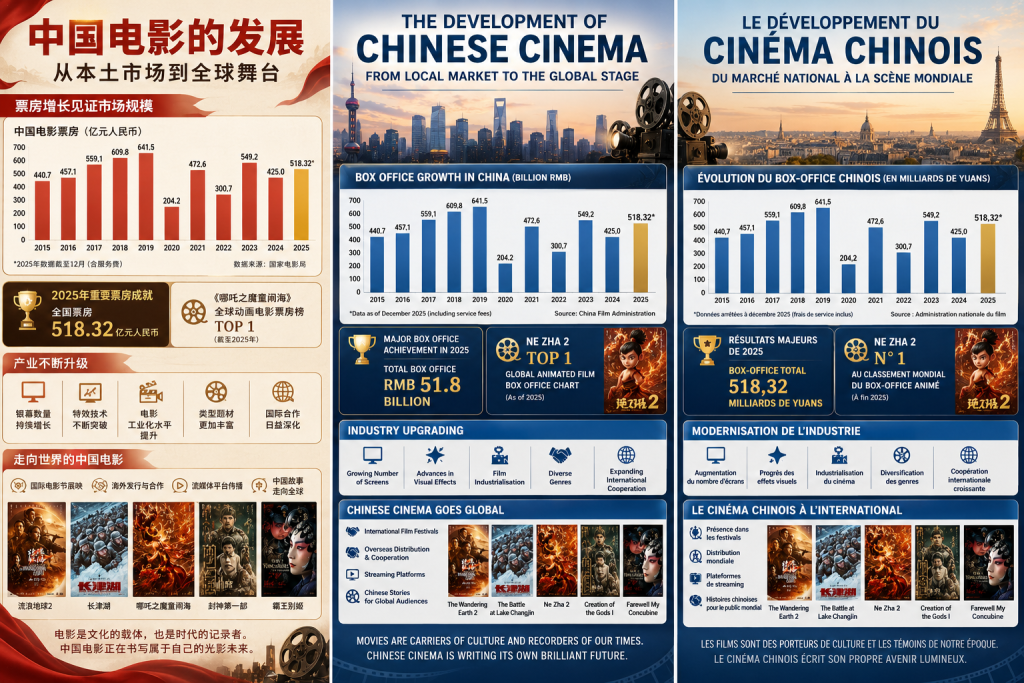
Box Office Growth Reflects Market Expansion
One of the most visible indicators of the development of China’s film industry is the rapid growth of its box office revenue.
From annual revenues of only a few billion yuan in its early years to hundreds of billions of yuan today, China’s film market has undergone a dramatic transformation. The construction of cinemas, the increase in the number of screens, the establishment of moviegoing habits among urban audiences, and the maturity of major release periods such as the Spring Festival, Summer Holiday, and National Day seasons have all contributed to making China one of the world’s most important film markets.
China’s annual box office reached approximately RMB 42.5 billion in 2024. Although the market experienced some adjustment due to changes in film supply and consumer behavior, it remained one of the largest in the world. In 2025, the market rebounded strongly, with total box office revenue exceeding RMB 51.8 billion, demonstrating the resilience of domestic demand and the strength of local content production.
Particularly noteworthy is the growing dominance of domestic productions. From Wolf Warrior 2 and The Battle at Lake Changjin to The Wandering Earth series and the animated blockbuster Ne Zha 2, Chinese films have repeatedly broken national box office records. Their success reflects audiences’ strong demand for Chinese stories, diverse genres, and high-quality industrial filmmaking.
The Maturation of Genre Cinema
As the market has expanded, Chinese cinema has also become increasingly diverse in terms of genres and themes.
Historical epics, social dramas, science-fiction films, animated features, action movies, comedies, and suspense thrillers have all developed into increasingly mature sectors of the industry.
In recent years, Chinese science-fiction cinema has attracted particular attention. The success of The Wandering Earth series demonstrated the growing sophistication of China’s film industry and highlighted advances in visual effects, large-scale project management, and world-building capabilities.
At the same time, a growing number of realist films have focused on the lives of ordinary people and the social transformations taking place across the country, strengthening the emotional connection between films and audiences.
Continuous Progress in Film Industrialization
The development of the film industry is not reflected solely in box office figures.
From script development and project financing to production, post-production, marketing, and international distribution, China’s film industry has steadily built a more comprehensive industrial ecosystem.
In recent years, film studios, digital production technologies, virtual production systems, and artificial intelligence-assisted filmmaking have become increasingly integrated into production workflows, creating new opportunities for innovation and efficiency.
This process of industrialization has improved both production quality and international competitiveness.
Expanding International Cooperation and Global Reach
As China’s film market has grown, international cooperation has become increasingly important.
Chinese directors, actors, producers, and film companies are now regularly represented at major international film festivals, film markets, and cultural exchange events. Through festival screenings, theatrical releases, streaming platforms, and international rights sales, Chinese films are reaching wider audiences around the world.
At the same time, Chinese film companies are actively participating in co-productions, overseas distribution partnerships, and international investment projects.
These exchanges not only help Chinese cinema reach global audiences but also contribute to greater cultural understanding and dialogue between different societies.
New Opportunities in the Streaming Era
Digital technology is reshaping the global film industry.
The rise of streaming platforms has enabled films to enter international markets more quickly and has provided new opportunities for independent filmmakers, emerging directors, and niche productions.
An increasing number of Chinese films are gaining visibility through global streaming services. For China’s film industry, digital distribution not only expands market access but also creates new channels for cultural outreach and international engagement.
From Market Size to Cultural Influence
The future of Chinese cinema is about more than continued box office growth.
As audience expectations continue to rise, the industry is shifting from a focus on quantity to a focus on quality. Original storytelling, genre innovation, industrial production capabilities, and international communication strategies will determine whether Chinese cinema can achieve greater influence on the global stage.
The ability to tell stories that are deeply rooted in Chinese culture while also resonating with international audiences will be crucial to the industry’s long-term success.
From domestic growth to global engagement, Chinese cinema is undergoing a significant transformation—from expanding market scale to enhancing quality, and from commercial success to cultural influence. As its industrial foundations continue to strengthen and international cooperation deepens, China’s film industry is poised to play an increasingly important role in the global cinematic landscape.
© Euro International Press | Europa Post
Source: Euro International Press
Photo / Image: Image: EIPRESS editorial visual.
This article is based on publicly available information or editorial materials and does not imply endorsement by any institution mentioned unless expressly stated.
Published by Euro International Press (France). Individual readers, schools, associations and non-commercial organisations may republish this article while retaining the title, text and source. Media organisations, commercial websites, news platforms, aggregators and commercial entities should contact info@gche.eu for authorisation, syndication or partnership.
© Euro International Press. All Rights Reserved.