World Cup 2026 as a Global Cultural Event: Football, Cities and Shared Identity
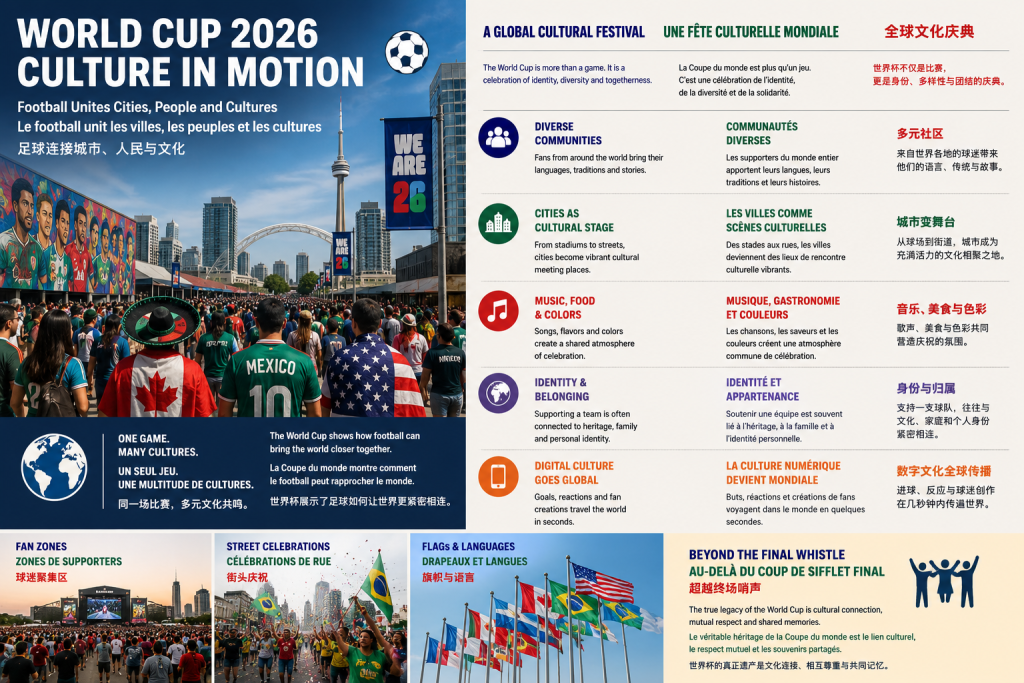
The 2026 FIFA World Cup will be followed first as a football tournament, but its broader significance goes far beyond the pitch. Across host cities in North America, the event will also become a global cultural moment, bringing together languages, flags, food, music, migration stories, public celebrations and shared emotions.
Unlike a regular sports competition, the World Cup creates a temporary cultural map. Airports, hotels, public squares, cafés, fan zones, streets and stadium districts become meeting points for people from different countries and backgrounds. For a few weeks, football becomes a common public language, understood by people who may not share the same nationality, religion, political view or mother tongue.
The 2026 edition is especially important because it will be hosted across the United States, Canada and Mexico. These three countries are deeply connected to migration, multilingual communities and cross-border cultural exchange. In many host cities, supporters will not simply arrive from abroad; they will also come from local diaspora communities that already live there. A match can therefore become a moment of cultural recognition as well as a sporting occasion.
This is one of the reasons the World Cup has such strong cultural power. A national team does not only represent a group of players. It can carry memories of family, language, childhood, homeland and identity. In multicultural cities, many fans support more than one team, reflecting the layered identities of contemporary urban life.
The cultural impact of the tournament will also be visible outside the stadium. Restaurants may adapt menus for visiting supporters, cultural institutions may organise related events, brands may design football-themed experiences, and local communities may use the tournament to present their music, food and traditions. The World Cup can briefly turn a city into a stage where local culture and global attention meet.
Digital culture will amplify this process. Goals, fan reactions, street celebrations, short videos and memes can travel around the world within minutes. A celebration in one neighbourhood can become a global image on social media. This digital layer makes the cultural life of the World Cup faster, more visual and more participatory than in previous generations.
However, the cultural success of the tournament will depend on more than crowded stadiums. Host cities must balance celebration with public order, commercial activity with local identity, and international attention with the everyday life of residents. If managed well, the World Cup can strengthen a city’s image as open, diverse and culturally confident. If managed poorly, it can become only a short commercial spectacle.
For media, institutions and cultural observers, the 2026 World Cup offers an important question: how can a major sporting event become a meaningful cultural exchange rather than only a branded entertainment product? The answer will depend on whether cities, communities and organisers give space to real local participation.
In the end, the most lasting images of the 2026 World Cup may not only be goals and trophies. They may also be streets filled with different languages, families wearing mixed colours, neighbours watching together, and cities showing how football can briefly transform the world into one shared public space.
—
Copyright Notice
This article is published by Euro International Press.
Individuals, schools, associations and non-commercial organisations may republish the article provided the title, content and source information remain unchanged and the source is clearly credited as Euro International Press (eipress.eu).
Media organisations, commercial websites, news platforms, syndication services and other commercial entities wishing to reproduce, translate, adapt, republish or commercially distribute this content should obtain prior authorisation.
Licensing & Syndication:
info@gche.eu
© Euro International Press. All Rights Reserved.
Source: Euro International Press
Photo / Image: Image: EIPRESS editorial visual.
This article is based on publicly available information or editorial materials and does not imply endorsement by any institution mentioned unless expressly stated.
Published by Euro International Press (France). Individual readers, schools, associations and non-commercial organisations may republish this article while retaining the title, text and source. Media organisations, commercial websites, news platforms, aggregators and commercial entities should contact info@gche.eu for authorisation, syndication or partnership.
© Euro International Press. All Rights Reserved.