Smart Homes Move Beyond Convenience as Europe Focuses on Energy Efficiency
Euro International Press, Paris — Smart home technology is entering a new stage in Europe. Once associated mainly with lighting, security cameras and voice assistants, connected homes are increasingly becoming part of a wider debate on energy efficiency, grid flexibility and the future of residential living.
The shift is being driven by several forces. European households are facing pressure from energy prices, hotter summers, electrification and the growing use of connected appliances. At the same time, policymakers and technology companies are trying to make devices more interoperable, so that appliances, heating systems, electric vehicle chargers and energy management tools can communicate more easily.
The European Commission’s Joint Research Centre has expanded its Code of Conduct for energy smart appliances, aiming to promote interoperability between devices and the power grid. The goal is not only to make homes more comfortable, but also to help electricity systems respond to demand peaks, renewable energy fluctuations and household consumption patterns.
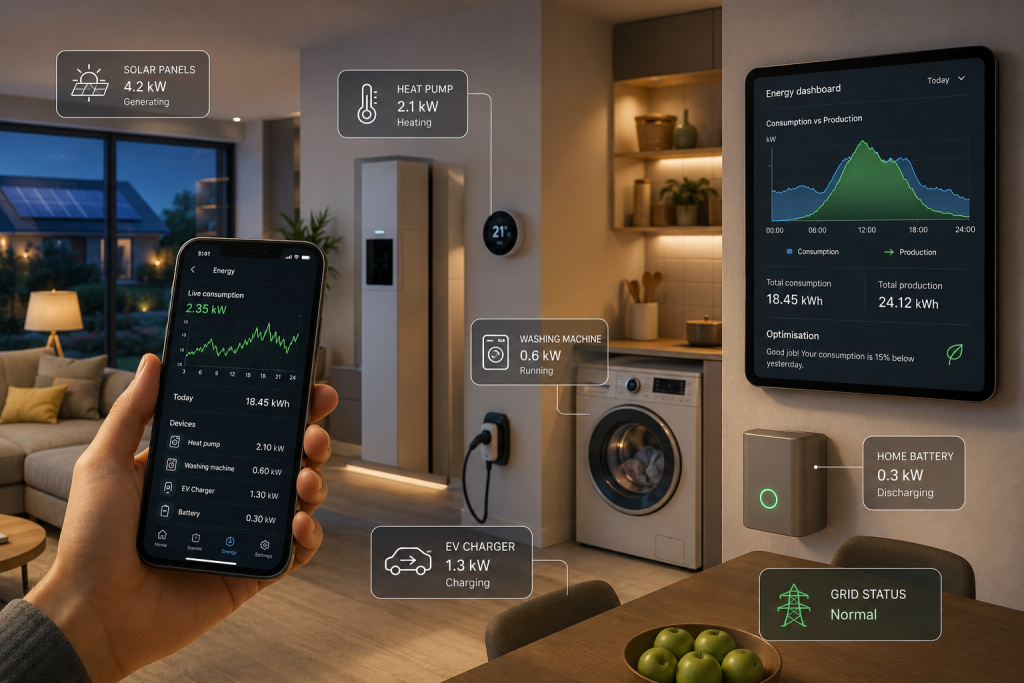
Industry standards are moving in the same direction. The Matter smart home standard is designed to allow devices from different brands to work together more smoothly, while new cooperation with demand-response technologies could help household appliances adjust electricity use when the grid is under pressure. In practical terms, future washing machines, heat pumps, batteries, smart plugs and EV chargers could become part of a more flexible energy ecosystem.
For consumers, the appeal of smart homes is also changing. Convenience remains important, but energy savings, safety, privacy and long-term compatibility are becoming equally significant. A smart home that only controls lights may no longer be enough. Households increasingly expect systems that can monitor consumption, reduce waste, improve indoor comfort and integrate with solar panels or dynamic electricity tariffs.
There are still challenges. Smart devices must remain easy to use, affordable and secure. Consumers also need confidence that connected appliances will not lock them into one brand or expose sensitive household data. Without clear standards and strong privacy protections, the smart home market could remain fragmented.
For Europe, the connected home is becoming part of the energy transition. As buildings are upgraded and electricity systems become more digital, smart appliances may play a larger role in reducing bills, improving comfort and supporting grid stability. The smart home of the future may be less about novelty and more about resilience.
—
Copyright Notice
This article is published by Euro International Press.
Individuals, schools, associations and non-commercial organisations may republish the article provided the title, content and source information remain unchanged and the source is clearly credited as Euro International Press (eipress.eu).
Media organisations, commercial websites, news platforms, syndication services and other commercial entities wishing to reproduce, translate, adapt, republish or commercially distribute this content should obtain prior authorisation.
Licensing & Syndication:
info@gche.eu
© Euro International Press. All Rights Reserved.
Source: Euro International Press
Photo / Image: Image: EIPRESS editorial visual.
This article is based on publicly available information or editorial materials and does not imply endorsement by any institution mentioned unless expressly stated.
Published by Euro International Press (France). Individual readers, schools, associations and non-commercial organisations may republish this article while retaining the title, text and source. Media organisations, commercial websites, news platforms, aggregators and commercial entities should contact info@gche.eu for authorisation, syndication or partnership.
© Euro International Press. All Rights Reserved.