
Global AI Competition: Who Will Lead the Next Technological Revolution?
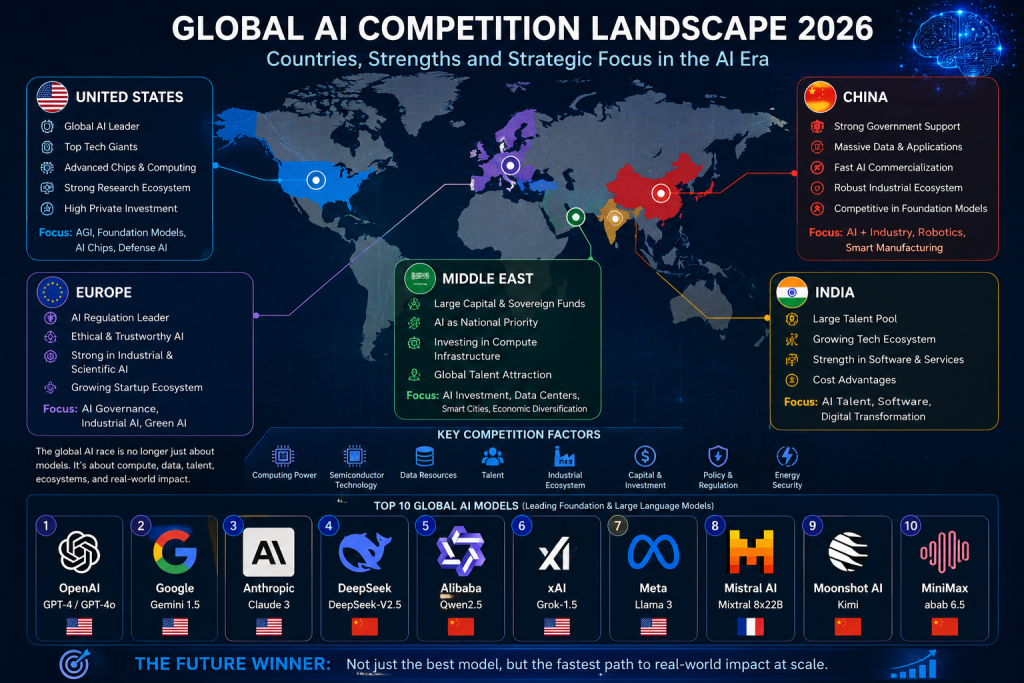
A Special Report by Europa Business Weekly
Artificial intelligence is no longer merely a technological innovation.
From large language models and autonomous driving to smart manufacturing, national defense, financial services, and healthcare, AI is reshaping the structure of the global economy. More and more countries now view artificial intelligence as a critical component of national competitiveness. Over the next decade, competition in the AI sector is likely to influence not only technological and economic development but also the future geopolitical landscape.
United States: Maintaining a Global Lead
In the current global AI landscape, the United States remains at the forefront.
The country is home to some of the world’s most influential technology companies, including OpenAI, Google, Microsoft, Meta, Amazon, and NVIDIA.
These companies not only possess world-class research teams but also control vast computing resources, advanced semiconductor technologies, and large-scale cloud infrastructure. In particular, American firms continue to hold a significant advantage in the development of foundation models and large language models.
In addition, the United States benefits from a mature venture capital ecosystem and strong collaboration between academia and industry, providing continuous momentum for innovation.
China: The Strongest Challenger
China has emerged as the most significant AI power outside the United States.
In recent years, China has made rapid progress in AI applications, data resources, digital economy development, and industrial deployment. Chinese companies have accumulated extensive experience in smart manufacturing, smart cities, mobile payments, recommendation systems, autonomous driving, and industrial AI.
A new generation of Chinese AI companies, represented by DeepSeek, is accelerating the development of domestic foundation models.
At the same time, China has established strong industrial advantages in robotics, electric vehicles, drones, and intelligent hardware. In the future, China’s greatest strength may lie not only in model performance but also in its ability to deploy AI rapidly across large-scale industrial ecosystems.
Europe: Focused on Regulation and Trustworthy AI
Compared with the United States and China, Europe’s strengths are not primarily based on the scale of its internet platforms.
Instead, Europe places greater emphasis on AI governance, ethics, and trustworthy technology.
The European Union has taken the lead in establishing AI regulatory frameworks and introduced pioneering legislation such as the AI Act. Europe aims to ensure that technological progress aligns with public interests and social values while continuing to encourage innovation.
France, Germany, the United Kingdom, and several Nordic countries are significantly increasing investment in AI research and development. Cities such as Paris, London, Berlin, and Amsterdam are becoming important centers for AI innovation and entrepreneurship.
Although Europe currently lags behind the United States in foundation model development, it remains highly competitive in industrial AI, healthcare AI, and advanced manufacturing technologies.
The Middle East: Accelerating Through Capital Investment
In recent years, Middle Eastern countries have emerged as major investors in artificial intelligence.
Saudi Arabia, the United Arab Emirates, and Qatar have all incorporated AI into their national development strategies.
With substantial financial resources, these countries are seeking to diversify their economies and reduce dependence on traditional energy industries. Investments in large-scale data centers, AI-focused funds, and international technology partnerships are increasing rapidly.
Many global AI companies now view the Middle East as an important future market and investment destination.
India: One of the World’s Largest Talent Pools
India possesses one of the largest technology talent pools in the world.
Over the past several years, India has actively promoted digital transformation and achieved notable progress in software development, cloud computing, IT services, and AI talent cultivation.
Although India still faces challenges in computing infrastructure and capital investment compared with China and the United States, its vast population and large engineering workforce provide significant long-term potential.
In the years ahead, India could become a leading global hub for AI services, software development, and digital innovation.
The Next Competition: Beyond AI Models
Over the past few years, global attention has focused heavily on large language models.
However, future competition will involve far more than simply developing more powerful models.
Computing infrastructure, semiconductor technology, energy availability, data resources, industrial ecosystems, education systems, and talent development will all play decisive roles.
Countries that successfully integrate AI into industry, finance, education, healthcare, and public services may ultimately gain a greater competitive advantage than those that merely possess advanced AI models.
Who Will Win the Future?
At present, the United States continues to lead, China remains the strongest challenger, Europe exerts influence through regulation and governance, the Middle East is accelerating investment-driven development, and India is leveraging its talent resources to advance rapidly.
Yet the AI revolution is still in its early stages.
History has shown that every major technological revolution reshapes the global balance of power. Over the next decade, artificial intelligence may transform economies and societies even more profoundly than the internet revolution.
The ultimate winner may not be the country with the most powerful AI model, but the one that can most effectively transform artificial intelligence into productivity, innovation, and sustainable economic growth.
© Euro International Press | Europa Business Weekly
Source: Euro International Press
Photo / Image: Image: EIPRESS editorial visual.
This article is based on publicly available information or editorial materials and does not imply endorsement by any institution mentioned unless expressly stated.
Published by Euro International Press (France). Individual readers, schools, associations and non-commercial organisations may republish this article while retaining the title, text and source. Media organisations, commercial websites, news platforms, aggregators and commercial entities should contact info@gche.eu for authorisation, syndication or partnership.
© Euro International Press. All Rights Reserved.